The Hidden Risks of Krabi’s Soil
Why a 25,000 THB Soil Test Saves You 2,000,000 THB in Foundation Repairs
For many investors, Krabi is the ultimate destination for luxury real estate. The dramatic limestone cliffs, the lush jungle canopies, and the proximity to the Andaman Sea create a world-class backdrop for high-end villas. However, beneath this tropical paradise lies a complex and often treacherous geological reality.
In the construction industry, a building is only as good as the ground it stands on. In Krabi, that ground can vary from solid bedrock to expansive clay or soft alluvial silt within just a few meters. Choosing to build without a professional Geotechnical Soil Analysis is not an act of saving money; it is a high-stakes gamble with your entire capital.
As a professional project management firm, Krabi Contractor (KC) advocates for the “Problem-Setting” approach. Here is why investing 25,000 THB today is the only professional way to prevent a 2,000,000 THB catastrophe tomorrow.
1. The Diversity of Krabi’s Geology: A Developer’s Minefield
Krabi’s landscape is famous for its “Karst” topography—the limestone mountains that rise abruptly from the plains. While beautiful, this geological history means the soil composition is rarely uniform.
- The Limestone Cave Risk: Areas near cliffs often have underground voids or “solution cavities.” If your foundation sits above a hidden cavity, the weight of a villa can cause a sudden and catastrophic collapse.
- The Expansive Clay Factor: Low-lying areas in Ao Nang and Nong Thale often contain clay that expands when wet and shrinks when dry. This seasonal movement exerts massive pressure on concrete footings, leading to “shear failure” where the house literally tears itself apart.
- The Silt and Alluvial Deposit Issue: Land near the coast or old waterways often consists of soft silt. Without deep piling, a heavy structure will gradually “sink” or “tilt,” a process known as differential settlement.
2. What is a 25,000 THB Soil Test? (The Science of Security)
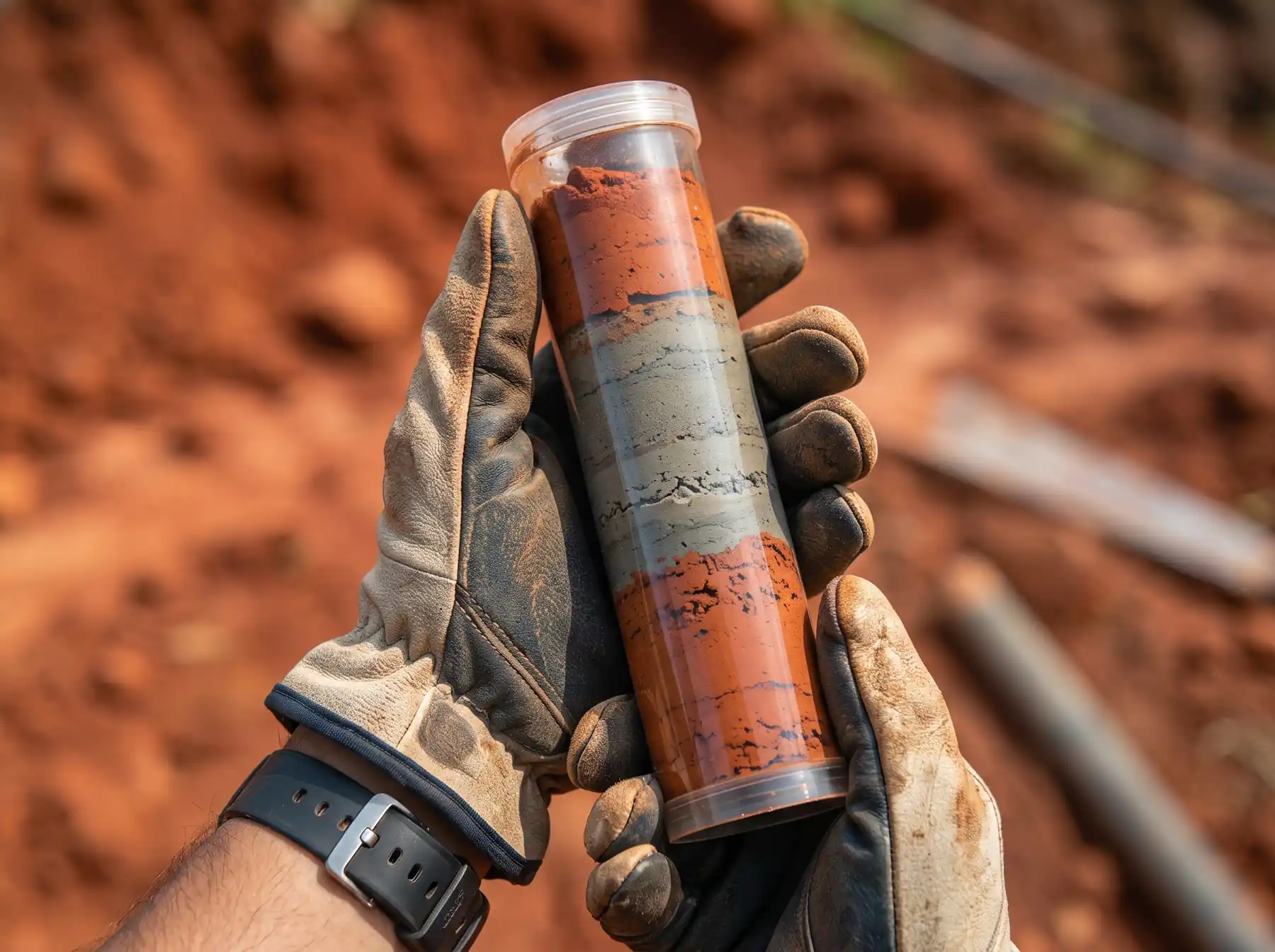
A professional soil test (borehole test) is a surgical procedure for your land. We bring a specialized drilling rig to the site to extract “cores” of earth from depths of 6 to 15 meters. These samples are analyzed in a laboratory to determine the Soil Bearing Capacity.
This report provides our structural engineers with the “N-Value”—a mathematical measurement of how much weight each square meter of soil can support.
- Without this data: Your architect is “guessing.”
- With this data: Your engineer can design a foundation that is mathematically guaranteed to support the structure.
3. The 2,000,000 THB Nightmare: The Cost of Foundation Failure
When a foundation fails due to poor soil preparation, the symptoms do not appear immediately. They usually emerge 24 to 36 months after completion, often after the first major monsoon season.
The Financial Breakdown of Failure:
- Underpinning and Structural Repair (800,000+ THB): Once a house begins to tilt or sink, the only fix is “underpinning”—injecting chemical grout or installing micro-piles beneath the existing floor. This is a massive, invasive engineering operation.
- Plumbing and Utility Rupture (200,000+ THB): As the house sinks, the rigid PVC pipes for water and sewage break beneath the slab. Fixing these leaks requires jackhammering up your expensive Italian tiles or hardwood floors.
- Waterproofing Failure (300,000+ THB): Movement in the foundation causes the waterproof membranes in bathrooms and swimming pools to tear. In a tropical climate, this leads to rot and mold.
- Property Devaluation (1,000,000+ THB): A house with a “structural repair” history is almost impossible to sell at full market value. Savvy buyers will walk away the moment they see signs of settlement.
Total Estimated Loss: 2,000,000 THB+ and months of administrative stress.
4. Preventing “Over-Engineering” (The ROI of Data)
Ironically, a soil test can also save you money by preventing Over-Engineering.
Many contractors in Krabi, fearful of a collapse but lacking data, will insist on expensive “deep piles” everywhere. Piling is costly. If the soil test reveals that your land sits on stable bedrock just 3 meters down, you can use a “Spread Footing” foundation instead. In this scenario, the 25,000 THB soil test could actually save you 300,000 THB in unnecessary construction costs.
5. The Role of the Project Manager in Risk Mitigation
At Krabi Contractor, we represent the owner’s interests. Our “Problem-Setting” philosophy mandates that Phase 2 (Technical Planning) is never skipped.
We coordinate the Geotechnical Analysis and integrate the findings into the Master Blueprint. We ensure that the Building Permit is based on geological facts, not optimistic assumptions. This technical rigor is why KC-managed projects are recognized by insurance partners like Globe Insurance as lower-risk investments.
6. Why “Standard Practice” in Krabi Isn’t Good Enough
Many local builders will say: “I built the house next door; I know the soil there is fine.” This is a dangerous fallacy. Soil profiles can change drastically within just 10 meters. In professional development, “experience” is not a substitute for “empirical data.”
Conclusion: Engineering Security for Your Legacy
Your villa in Krabi is more than just a building; it is a legacy and a significant financial asset. Protecting that asset begins with the earth it sits on.
Investing 25,000 THB for a Geotechnical Soil Analysis is the most cost-effective insurance policy you will ever buy. It provides the structural certainty that allows you to sleep at night, even during the heaviest tropical downpours.
Krabi Contractor: We identify the risks so you can enjoy the results.