ASEAN: The Strategic Guide to Southeast Asia’s Economic Integration, Trade Frameworks, and Regional Investment
Introduction: The Engine of Southeast Asian Economic Growth
The Association of Southeast Asian Nations (ASEAN) represents one of the world’s most dynamic, rapidly expanding regional economic blocs. Encompassing over 680 million people and a collective Gross Domestic Product (GDP) surpassing $3.8 trillion USD, ASEAN has transitioned from a diplomatic dialogue forum into a global powerhouse for trade, manufacturing, digital innovation, and foreign direct investment (FDI).
For international corporations, institutional funds, and private high-net-worth investors, understanding ASEAN’s regulatory architecture, cross-border trade treaties, and geopolitical positioning is vital. As supply chains diversify globally and capital shifts toward high-growth emerging corridors, ASEAN stands as the epicenter of Southeast Asian economic prosperity.
1. Origins, Expansion, and the 11 Member States
Founded on August 8, 1967, through the signing of the Bangkok Declaration in Thailand, ASEAN was initially established by five founding nations—Indonesia, Malaysia, the Philippines, Singapore, and Thailand—to foster regional stability and economic collaboration.
Over the decades, the bloc expanded across mainland and maritime Southeast Asia. Following a historic multi-year accession roadmap, the bloc formally welcomed its 11th member state:
- Brunei Darussalam
- Cambodia
- Indonesia
- Laos
- Malaysia
- Myanmar
- Philippines
- Singapore
- Thailand
- Vietnam
- Timor-Leste (11th Member State)
2. The Three Pillars of the ASEAN Community
ASEAN operates under a consensus-driven governance model known as the “ASEAN Way,” prioritizing mutual respect, non-interference in domestic affairs, and peaceful dispute resolution. The bloc’s integration is anchored by three foundational pillars:
I. The ASEAN Economic Community (AEC)
The AEC creates a single market and production base designed to facilitate the free flow of goods, services, investment capital, and skilled labor across Southeast Asia. Through initiatives like the upgraded ASEAN Trade in Goods Agreement (ATIGA) and single-window customs systems, non-tariff barriers are continuously dismantled to accelerate cross-border commerce.
II. The ASEAN Political-Security Community (APSC)
The APSC ensures regional stability, maritime security, and diplomatic cohesion. By maintaining “ASEAN Centrality,” the bloc serves as the primary diplomatic anchor for East Asian security dialogues and international relations with global powers.
III. The ASEAN Socio-Cultural Community (ASCC)
The ASCC focuses on human capital development, environmental sustainability, green energy transitions, and disaster management cooperation across member states.
3. Global Trade Architecture: RCEP and the Digital Economy
ASEAN does not operate in isolation; it sits at the center of the world’s largest free trade networks, granting businesses operating within member states privileged access to global consumer markets.
The Regional Comprehensive Economic Partnership (RCEP)
ASEAN is the core architect of RCEP, the world’s largest free trade agreement. Uniting all ASEAN members alongside China, Japan, South Korea, Australia, and New Zealand, RCEP encompasses:
- Approximately 30% of the world’s total population.
- Roughly 30% of global GDP.
- Unified rules of origin and progressive tariff eliminations, enabling seamless supply chain integration across the Asia-Pacific region.
The ASEAN Digital Economy Framework Agreement (DEFA)
As Southeast Asia’s digital economy accelerates toward $1 trillion USD, ASEAN has established DEFA. This groundbreaking regional pact establishes unified standards for cross-border data flows, paperless digital trade, electronic payments, cybersecurity, and artificial intelligence governance.
4. Thailand’s Strategic Role as the Gateway to ASEAN
Situated at the geographical and logistical heart of mainland Southeast Asia, Thailand acts as the premier launchpad for businesses expanding across the ASEAN region.
Centralized Logistics and Infrastructure
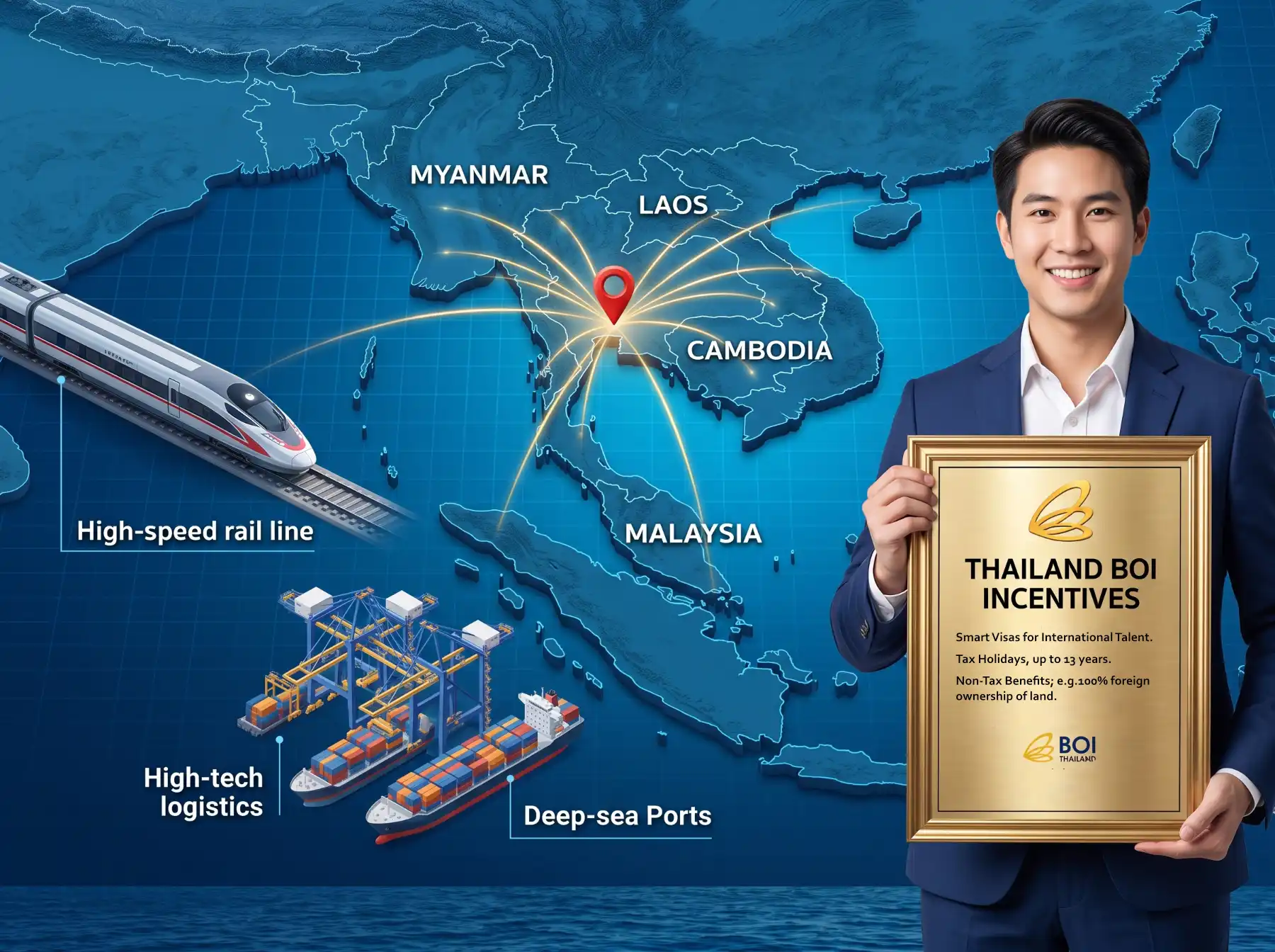
Thailand provides direct overland transport links to Cambodia, Laos, Myanmar, and Malaysia, connected via modern deep-sea ports (such as Laem Chabang) and extensive highway networks. Major national infrastructure projects—including high-speed rail lines and international airport expansions—further enhance regional connectivity.
The Board of Investment (BOI) Advantage
To attract high-value multinational operations, the Thailand Board of Investment (BOI) offers comprehensive statutory incentives for companies utilizing Thailand as a regional base:
- 100% Foreign Corporate Ownership: Bypassing standard foreign equity restrictions in promoted high-tech, logistics, and hospitality sectors.
- Freehold Land Rights (Section 27): Permitting qualifying foreign-owned enterprises to hold freehold land titles (Chanote) for commercial facilities, regional headquarters, and staff housing.
- Corporate Tax Holidays: Providing up to 13 years of 0% corporate income tax (CIT) and complete import duty exemptions on advanced machinery.
- International Business Center (IBC) Schemes: Offering streamlined regulatory frameworks and Smart Visas for foreign technical experts, executives, and regional management teams.
5. Navigating Regional Real Estate and Capital Deployment
As economic integration deepens across ASEAN, demand for high-end residential real estate, commercial hubs, and wellness resorts in prime lifestyle corridors continues to expand.
In secondary lifestyle markets such as Krabi (Ao Nang, Khlong Muang, Tubkaek), international capital is increasingly deployed into sustainable luxury developments:
- Tangible Asset Security: Balancing liquid international investments with high-yield, tangible assets such as 3-bedroom contemporary luxury pool villas.
- Compliant Ownership Frameworks: Utilizing legal statutory mechanisms under Thai law—including registered 30-year leaseholds, superficies rights, and 100% freehold ownership of physical structures—to eliminate asset vulnerability.
- Technical Due Diligence: Deploying a “Problem-Setting” methodology that combines geodetic RTK-GPS surveys, geotechnical soil core drilling, and municipal zoning audits before capital is committed to raw land.
6. Frequently Asked Questions (FAQ)
How many member countries are in ASEAN?
ASEAN comprises 11 member nations: Brunei, Cambodia, Indonesia, Laos, Malaysia, Myanmar, the Philippines, Singapore, Thailand, Vietnam, and Timor-Leste.
What is the primary purpose of the ASEAN Economic Community (AEC)?
The AEC aims to establish a deeply integrated single market and production base across Southeast Asia, facilitating the tariff-free movement of manufactured goods, professional services, investment capital, and skilled labor.
What trade advantages does RCEP offer to businesses operating in ASEAN?
RCEP connects ASEAN with China, Japan, South Korea, Australia, and New Zealand under a unified free trade framework. It eliminates tariffs on up to 90% of traded goods and standardizes regional supply chain rules across member economies.
How does Thailand’s BOI support foreign companies expanding in the ASEAN market?
The Thailand Board of Investment (BOI) allows qualifying foreign corporations to maintain 100% foreign equity, acquire freehold commercial land, enjoy multi-year corporate tax exemptions, and access fast-track visas for international executives and technical specialists.
Establish Your Regional Foothold with Krabi Contractor
Capitalizing on Southeast Asia’s rapid economic expansion requires experienced, on-the-ground technical and legal management. Backed by 18 years of local experience, Krabi Contractor Co., Ltd. serves as your fiduciary partner and project leader in southern Thailand.
From strategic land acquisition and corporate BOI engineering to precision civil design, municipal permitting, and Western-standard construction management, we ensure your investments in the ASEAN region are built to endure.
Contact our Krabi headquarters today to schedule a strategic investment and development consultation.